
Unmatching Our Socks:
Challenging the Myths of Medicine

Unmatching Our Socks: Challenging the Myths of Medicine
by Steven Goldsmith, MD
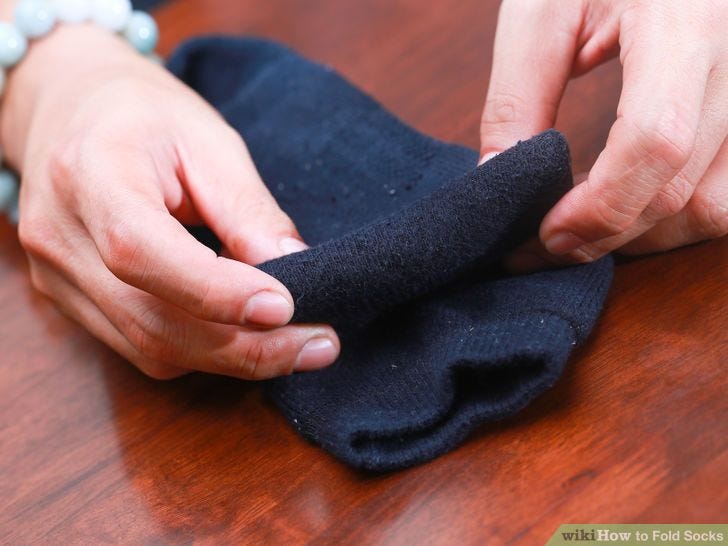
SOCKS
While dressing at the health club I made a discovery that disturbed me. After removing my sock ball from the gym bag and unrolling it, I realized that the socks didn’t match. One was ankle length and black; the other one, brown, extended to my lower calf and sported far more prominent ribs. In appearance they bore nothing in common. A control freak’s worst nightmare. The equivalent of shuffling down the street with visibly soiled jockey shorts and drool streaming from my mouth.
But who decreed that sock balls must contain identical members? Why do we adhere to this practice? After all, we do not require our shirts and blouses to coincide in every detail with our pants and skirts. Unless we are indigents or hipsters, we prefer to coordinate their colors and designs. Why can’t we coordinate our socks in like manner with, say, green on one foot and yellow on the other? Manuals of psychiatric disorders list symptoms no more irrational than our sock compulsion.
As I pondered this conundrum (I was not, by the way, under the influence of mind-altering substances—at the time), I realized that it represents one of countless examples of our uncritical acceptance of custom or the word of authority.
RECTAL EXAMS
When we were third year medical students our mentors expected us to perform comprehensive physical exams on new patients, with one exception. If we suspected any newly admitted patient of undergoing a heart attack, we were to defer the customary rectal exam, which otherwise we performed routinely to rule out enlarged or tumorous prostate glands in men or to check for impacted stool or occult blood. On write-ups of initial exams, we wrote Rectal Exam: deferred. That is the use of defer in the same way that Congress votes to defer balancing the federal budget to a later date. Defer as in never. We never eventually performed most of the deferred rectal exams, even when a patient proved after the first day of admission to have suffered not from a heart attack but gas.
The rationale for this deferral was physicians’ belief that the stress of rectal exams upon unstable hearts can trigger dangerous arrhythmias or other circulatory disturbances. We might kill our patients. Isolated case reports of such occurrences did exist. However, no good research supported the wholesale deferral of rectals. Nevertheless, our attending physicians and house staff allowed us to waive them. We did not look their gift horse in the mouth or any other orifice because rectal exams—uncomfortable, messy, and intrusive—are the least pleasant part of a physical exam for both patient and physician. Grateful for this dispensation, we colluded with our superiors.
Eventually a few intrepid researchers investigated the wisdom of this practice and found that in most heart attack cases, rectal exams inflict no harm and can uncover important medical problems. But guess what? Rectal exams still get deferred.
ULCERS
Another example from medical school, third year, springs to mind. In those days if you had a serious peptic ulcer, your doctor hospitalized you. Then s/he snaked a long rubber tube the diameter of a garden hose and coated with KY jelly through your nostril and past your throat into your stomach. (Hot diggity, Doc, sign me up.) These nasogastric tubes choked and gagged patients, caused their nostrils to bleed from the trauma. But that was not the end of their ordeal. After placement of the tubes, every half hour nurses poured into them two tablespoons of liquid antacid, milk, or cream. When I envision those wretched patients, I think of Guantanamo detainees. But this was the standard medical practice.
One morning during bedside rounds a classmate presented the case of an ulcer patient to our Chief of Medicine, who had the personality of an electric drill bit. The student reported that his patient received regular tube feedings of a combination of Maalox and half-and-half. A flicker ignited the Chief’s usually dead eyes.
“What is the composition of half-and-half?” he hissed.
The student guessed wrong. So our Chief spent the next fifteen minutes castigating him for his ignorance in front of his patient and classmates. The best I can say about the Chief as a role model is that he was not Josef Mengele.
But my point is our uncritical acceptance of authority, especially true of physicians. We tend to obey, to unquestioningly adhere to precedent. Medical training selects and curates perfectionists accustomed to achieving straight As, academic honors, and professional recognition by conforming to institutional expectations. And by the time we have established our practices we have accumulated too much debt, professional reputation, and material goodies to risk ruffling the feathers of administrators and medical boards with our heterodox views. As the coup de grace to the exercise of independent critical thinking by physicians, the corporatization of medical practice has molded most of us into compliant drones. Look for example at how physicians acquiesced at scale to our government’s and Pharma’s COVID shot psyop and the idiotic fetishization of useless masks. But they had historical company. By 1942 almost half of all German physicians had joined the Nazi party. According to historian E. Ernst, “Without the doctors’ active help. The Holocaust could not have happened.”1
By the way, subsequent research demonstrated that the above treatment of peptic ulcers was not only worthless but potentially harmful because milk and cream stimulate the secretion of stomach acid, not an outcome to enthuse you if you harbor a peptic ulcer.
MEDICINE AS AUTHORITY
Speaking of the uncritical acceptance of authority, do not accept ours. Do not automatically believe anything that mainstream medicine or its stenographers in the mainstream media report. (That goes for what I say as well.) Regardless of what we physicians and medical scientists assert, history indicates that we are likely to be wrong, and not just by a little bit, but massively, breathtakingly wrong. Consider, for example, academic medicine’s ridicule for two decades during the mid-nineteenth century of Dr. Ignaz Semmelweis’ bizarre notion and proof that handwashing prevents illness. Decades from now, our current medical practices will seem as barbaric and ludicrous as nineteenth century leeches and purges seem today.
We know little and spend our days feigning knowledge like everyone else. If we could recognize medical truth, we would actually be able cure you instead of stuffing you full of chemicals to take until Earth suffers the heat death. We would not be witnessing the inexorable rise in the per capita incidence in our society of almost every chronic illness, even in children. (Consult my book, The Healing Paradox, if you seek documentation and reasons.) Diagnoses and treatments would not change with the seasons. Medical research, allegedly a gold standard of truth, would no longer abound with error and fraud. (Even Dr. Richard Horton, editor-in-chief of the formerly esteemed journal Lancet, stated in 2015 that “much of the scientific literature, perhaps half, may simply be untrue.”) Sure, listen to us, but believe us at your peril. I am not advocating nihilism, just critical thinking.
And while we’re on the subject of suspect institutions, if you uncritically swallow anything that your government and major corporations tell you after their decades of lies, hypocrisies, and felonies, I have a diamond mine in Brooklyn I’d like to sell you. (But only if you call within the next fifteen minutes. Our operators are standing by.)
If we challenge authority or deviate from custom, we face risks. If we wear unmatched socks, especially if we wear them too openly, we jeopardize our emotional comfort, our safety and security, our acceptance by society. Or so we fear. Yet how much do we lose by wearing our socks matched for the rest of our days? And how much more can we grow and learn by unmatching them now and then?
“Nullius in Verba.” That was the motto of the British Royal Society, chartered in 1662 by Charles II. Roughly translated, it proclaims, “Accept No One’s Word” or “See for Yourself,” meaning that you must disregard what others say about the nature of reality and observe it for yourself. We need to bear this in mind when we open our sock drawers.
Be well.
References:
1) Ernst, E. Commentary: The Third Reich—German physicians between resistance and participation. Int’l J Epidemiology 2001; 30, Issue 1: 37-42
New subscriber.
First article I have read of yours.
Excellent advice and insight.
I was in the automotive aftermarket industry most of my working years and worked as a factory representative and promoted and trained customers on our products and how to properly install and promote them to their customers.
We were always encouraged to never discount anything as, that can’t happen, you can’t do it that way.
Why?
Because one can’t know everything about everything and a customer might have a better idea or an experience that might shine light on an existing issue concerning a product failure.
Always wondered why other industries didn’t do the same.
Now I know a little more about why they don’t. Maybe having miss matched socks is a trend that should be seriously considered.
Side note comparison
I never thought I would like a cat until one showed up on my property that needed help and a home. Over the years I have had four that needed help and I took them in.
Boy was I wrong. Cats are fascinating creatures that only a cat owner can truly understand.